COPERACY pursues a strategic advance on the assembly of cooperative catalytic systems designed from the atom/molecular to the macro-metric scales.
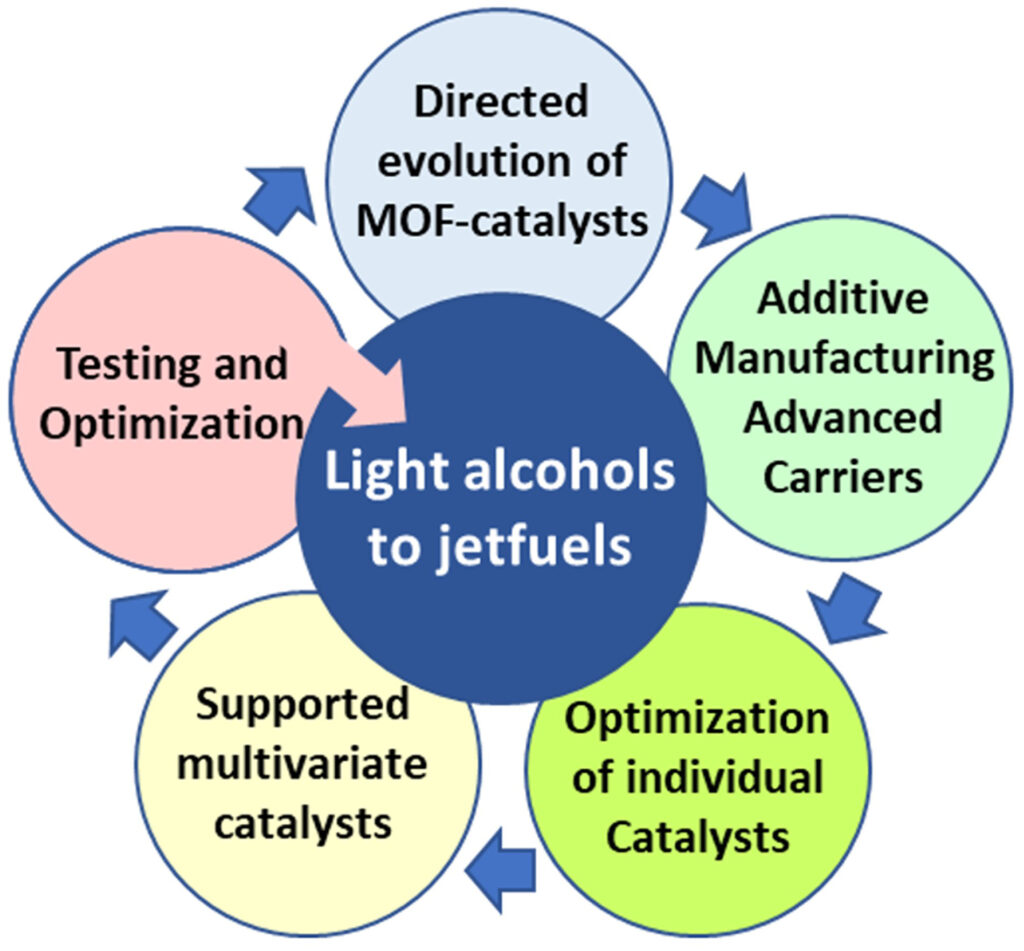
Such technology will be developed through the assembly of single atom/molecule bioinspired catalysts finely tuned under the principle of enzymatic directed evolution concept, and the combination and precise location of these function-tailored individual bioinspired catalysts onto tailor-made hierarchical porous carriers for maximizing the catalytic properties and enhance the bioinspired catalysts stabilization.
The cooperative catalysts technology developed in COPERACY will be operated under unconventional capillary condensation conditions in order to lower the energetic penalty, and improve the efficiency and specificity in biofuels synthesis from light alcohols.
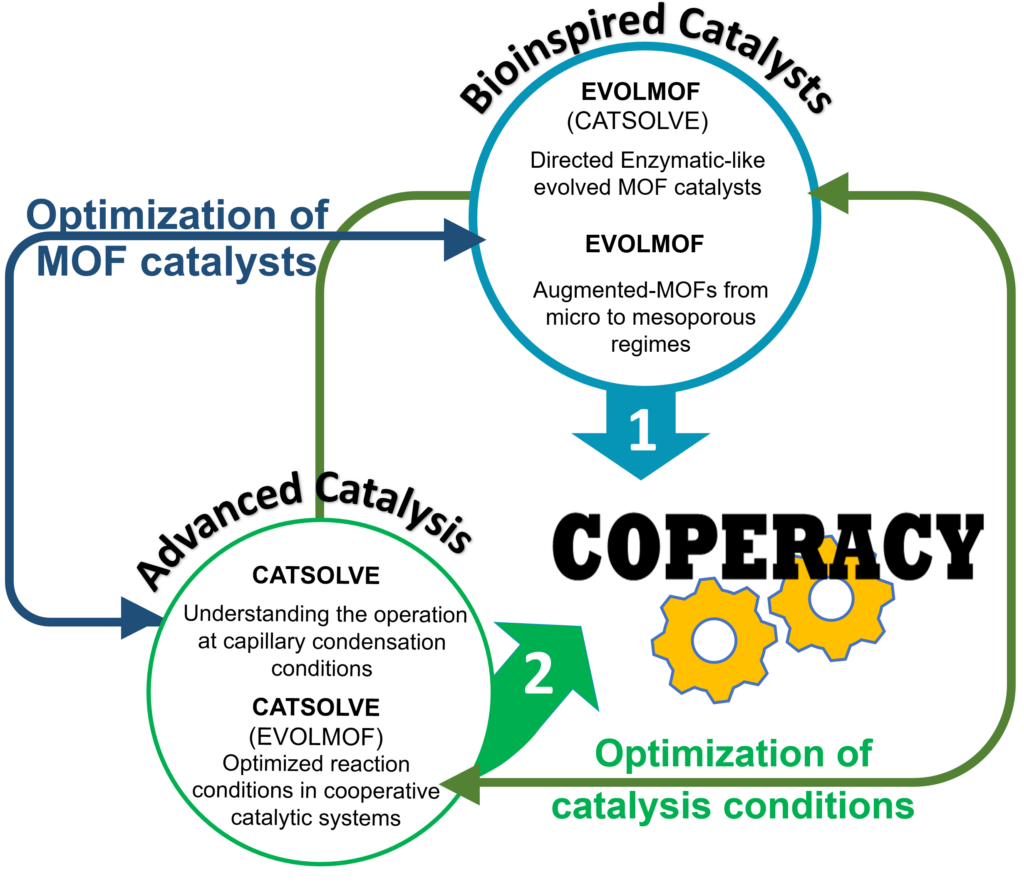
There are two subprojects that belong to COPERACY action:
EVOMOF subproject (developed by BCMaterials)
EVOLMOF will focus on the precise positioning and evolution of the coordination and micropore environments of metal-catalytic sites placed into robust and porous Metal-Organic Frameworks (MOFs). Starting from a topology guided design of the bioinspired MOF catalyst, EVOLMOF will transfer the artificial evolution strategy usually applied to enzymatic systems to the ordered structure of MOFs. By sequentially “mutating” the amino-acid like residues coordinating the catalytic metal-sites and these ones decorating the pore environment, we will tune steadily the catalytic function, selectivity and efficiency of the bioinspired MOF systems. The surgical positioning of the metallo-cores into the framework by a topology guided strategy, as well as the precise location of the pre- and post-synthetic functionalization in the MOF, will be EVOLMOF´s key fingerprints. Specific strategies will be selected, in coordination with EHU, to design bioinspired catalysts for the alcohol dehydration and dehydrogenation, aldolic coupling and olefins oligomerization steps of the explored catalytic routes. The capillary condensation will be studied at the start by developing augmented frameworks of MOF-catalysts already tested over the studied reactions (CAPSOLVE). In addition, the integration of the MOF catalysts within the advanced catalysts carriers (N-CATSU) will be initially studied with model compounds to later on apply the protocols to bioinspired advanced materials.
CAPSOLVE subproject (developed by SUPREN team at the University of the Basque Country)
CAPSOLVE will use pioneering chemical reaction engineering methods using alcohols and olefins as reactants in enzyme-like MOF catalysts (EvolMOF) supported on advanced carrier structures evolved using the enzymatic directed evolution concept. The CAPSOLVE subproject will be a flagship exemplary to overcome existing challenges in catalysis and provide new insights into the effects of solvents in reactors operating under gas-phase. We will combine multidisciplinary approaches in catalysis and integrate them with bioinspired catalysts with asymmetric and augmented pore spaces showing alcohol dehydration, dehydrogenation, olefin oligomerization and aldol-coupling activity. Functionalizations (EvolMOF) and metal-catalysts supported on high-flux and surface area carrier structures will be integrated in CAPSOLVE. This will benefit from a solvating capillary liquid nano-shell, itself at equilibrium with gas phase reactants featuring higher chemical potential than analogous bulk-liquids. This system aims to reach analogous solvating environments as those found in enzyme catalysis. The control over alcohol or olefin nano-shell physisorption and chemisorption will result in enhanced solvation of rate-determining TS versus conventional gas confinement. Such nano-shells will become even more attractive when their physicochemical properties are in-situ tuned. The knowledge generated on nano-shell—TS—active site interactions will set the basis for unique capillary condensation concepts, contributing to notable scientific gains and serving as inspiration for researchers specialized in areas such as materials science, spectroscopy and computational work.
INNOVATIVE ASPECTS
- Design of MOF catalysts under the enzymatic evolution like strategy
The topology guided multivariate and asymmetric functionalization of MOFs can give access to a precise engineering of the coordination number and binding-functions of the catalytic active metal-sites installed within MOFs, and hence, to steadily tune their catalytic performance and selectivity. In addition, reticular chemistry offers the possibility to generate catalytic sites with open reactive positions, while in parallel, tune the pore environments surrounding the active sites. - Novel reaction engineering concepts
The catalytic reactions under solely liquid- or gas-conditions are well-known. This is also the case when capillary condensation occurs in catalyst characterization techniques using probe molecules such as Ar or N2 in micro to meso-porous structures. Bringing such molecules into catalytic reactants, however, is an unexplored field that can lead to an improved catalysis in terms of yield, selectivity and catalysts´ stability under operation.